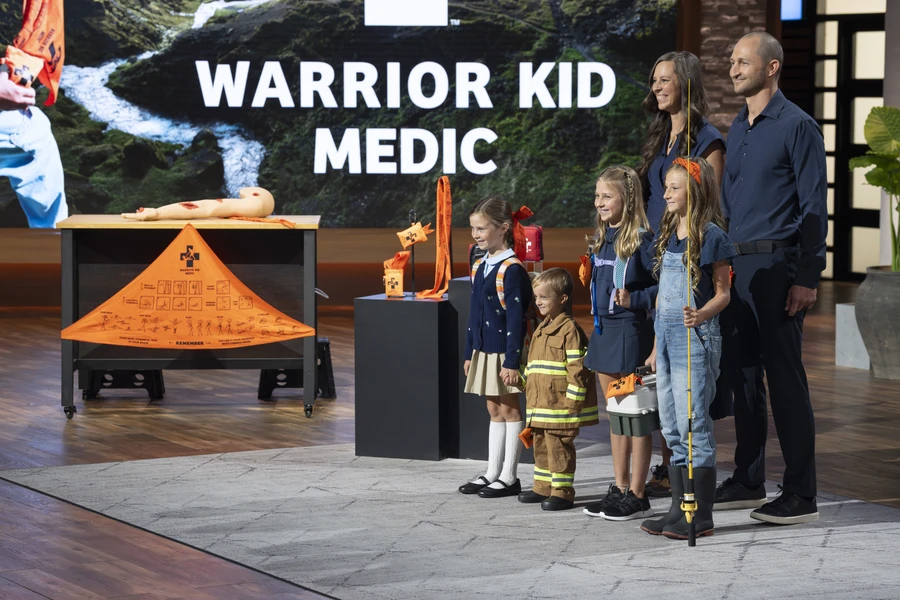
At the Titzman family’s dining table in rural Texas, eight-year-old Everly Titzman and her six-year-old sister Adeline calmly tend to a “punctured” plastic arm. They pack a gauze roll into a gaping wound and cinch an orange bandana around the faux limb as a tourniquet. “Shove it in there… you’re saving a life,” Everly grins, echoing her father’s training. It’s not a scene from a paramedic class but an ordinary evening at home. Dustin and Michelle Titzman’s four children have, in a sense, grown up playing first responder. This unusual family pastime is at the heart of Warrior Kid Medic, the company the Titzmans founded to empower children with real first-aid skills and confidence. What began as a personal mission to prepare their own kids has evolved into a budding business that puts professional-grade first aid tools in young hands – and teaches them how to use those tools to help others.
Dustin Titzman spent over two decades as a first responder, serving as a Texas firefighter-paramedic since 2003 and even flying Blackhawk helicopters in the Army Reserve. Over the years, he saw countless emergencies where “the outcome could have been better if somebody had just done something” before help arrived. Most bystanders, including children, simply didn’t know how to respond or were too afraid. His wife Michelle devoted herself to educating kids in a different setting – she founded a summer camp in 2012 called Camp SkyWay in Florida. By 2013 the two had married, eventually settling in Michelle’s hometown of Jourdanton, Texas, to raise their family. With Dustin’s lifesaving expertise and Michelle’s experience running youth programs, they shared a philosophy rooted in service and leadership. In bold letters on their wall at home they hung the family motto: “Do Good. Be Good. Share.” Once they became parents (their kids Penelope, Everly, Adeline, and Stokes are now 10, 8, 6 and 5), this ethos took on urgent meaning. “I want our kids to be prepared at home in case something happens and mom and dad aren’t around, because I see it all the time at work,” Dustin says. He started teaching the children basic first aid in casual, hands-on lessons. To his surprise, they soaked it up – even the youngest kids were eager to learn how to bandage a cut or splint a sprain. Their enthusiasm sparked an idea: what if all kids could learn these skills?
The Titzmans had already been introducing campers to rudimentary wilderness first aid at Camp SkyWay each summer. Dustin noticed how even fun, simple medical drills gave children a sense of accomplishment. With his own little ones now clamoring for more lessons at home, he saw an opportunity. The goal was no longer just keeping his family safe; it was to “turn bystanders into responders” on a larger scale. If kids could handle emergencies instead of panicking, they might save lives – or at least be calmer and more helpful in a crisis. This notion of a “warrior” mentality, as Dustin calls it, has nothing to do with combat and everything to do with character. To the Titzmans, a warrior is someone who works hard, stays humble, and steps up to help others in need. They began to envision a program (and tools) that could imbue ordinary kids with that mindset and practical know-how. By 2019, Dustin was sketching out lesson plans and kit ideas in his off-hours, laying the groundwork for what would become Warrior Kid Medic.
One of the first things Dustin looked for was a ready-made first aid kit for children. Already teaching his daughters how to tie tourniquets and treat injuries, he wanted to buy a kid-friendly kit so they could practice with real supplies. He soon discovered a problem: the only “children’s” first aid kits on the market were essentially toys – tiny plastic boxes with cartoon decals, a handful of Band-Aids, and maybe a sticker or two. “All the ones that were kid-friendly were like smiley face stickers and Band-Aids,” he recalls. “I was like, ‘No, how are they going to do a tourniquet? What about slings and splints and pressure wraps?’” In other words, the available kits assumed children couldn’t handle anything beyond minor scrapes. Dustin knew from experience that even kids as young as six or seven could learn to manage severe injuries if taught properly – but they needed the right tools scaled to their abilities. Since he couldn’t find a suitable product, he decided to create one.
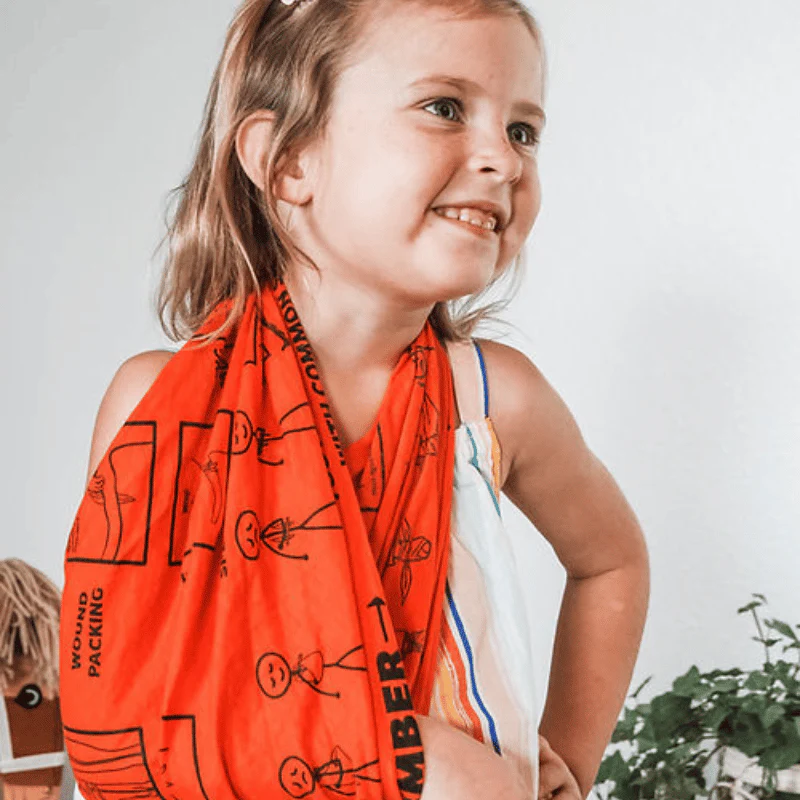
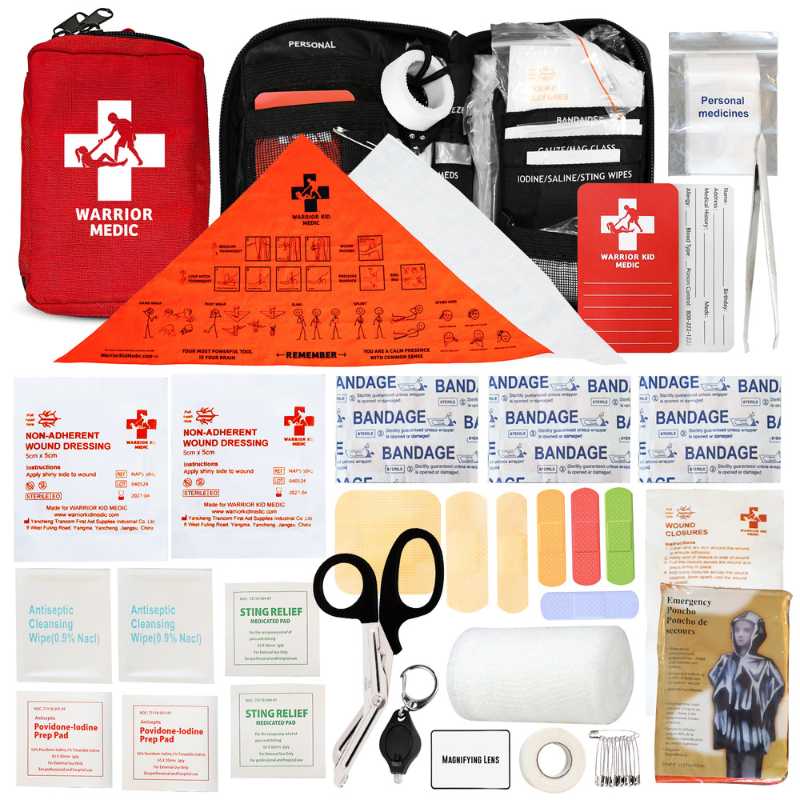
In 2021, Dustin set out to build a better youth first-aid kit from scratch. Drawing on his emergency medical knowledge, he compiled a list of items that would actually make a difference in a serious situation (tourniquets, bandages for stopping bleeding, etc.) yet be safe and simple enough for youth use. Central to his concept was a large triangular bandage, the kind medics call a cravat. This single piece of cloth could serve as a sling, pressure bandage, or improvised tourniquet – a true multi-tool in emergencies. “I made sure to add a triangle bandage to all our first aid kits,” Dustin later wrote, “but most are flimsy and not good to train with. Over time practicing with my 4 kids, I came up with this Warrior Kid Medic Triangle Bandage.” He designed his version to be sturdier and more informative than a standard cravat. The result was a giant orange cotton bandana (54×36×36 inches) printed with simple, kid-friendly first aid diagrams and tips. The cloth shows how to wrap a head wound, how to tie a sling, where to apply pressure for bleeding – right on the fabric itself. It even includes a QR code that lets users scan to access free how-to videos for each skill. By literally weaving the instructions into the tool, Dustin hoped to make it intuitive for anyone – a child or an adult – to follow the steps in an emergency. This signature item would later be called the Warrior Kid Medic Multi-Tool Bandage, and it embodies the company’s ethos: simple, versatile, and built for real-life emergencies.
While prototyping the bandage and kit, Dustin had help from an enthusiastic testing team – his kids. Evening after evening, the Titzman children practiced with their dad’s homemade first aid tools. Dustin even brought home a lifelike training prop arm (complete with pretend wounds) so they could rehearse treating severe injuries safely. The girls and their little brother took to it eagerly. They learned to tie the oversized bandage into a sling and fashion it into a pressure dressing. They packed fake wounds with rolls of cloth and figured out how to stop “bleeding” on the dummy arm by tightening the bandana as a tourniquet. If some part of the design didn’t work for small hands, Dustin adjusted it. In this way, the product was refined through real-world use by kids long before it ever hit the market. By the time the Titzmans were satisfied, they had something unique: a children’s first aid kit that wasn’t a toy at all, but a scaled-down professional kit – one a parent or EMT would respect, but that a child could actually use.
With the concept proven at home, Dustin and Michelle expanded it into a full program at Camp SkyWay. They started running a “Warrior Kid Medic” course at the summer camp, teaching campers how to stay calm and take action if someone gets hurt. Armed with Dustin’s large orange bandages and newly assembled kits, kids as young as 8 learned to do things like make splints out of sticks and wrap up bleeding limbs. The response was overwhelmingly positive. “Kids and parents loved it,” Dustin says of those early sessions. Children who might have been squeamish at the sight of blood were instead empowered – treating first aid like a cool skill to master. Parents began asking if they could buy the special bandage or get a kit to take home. Seeing this excitement, Michelle urged Dustin to think bigger. In 2022 she convinced him to bring Warrior Kid Medic to a national camp directors’ conference to gauge broader interest. There, other youth program leaders immediately saw the appeal. Many told the Titzmans that a hands-on first aid program for kids was “exactly what we’ve been looking for.” The encouraging feedback gave the couple the push they needed to turn Warrior Kid Medic from a side project into a real business.
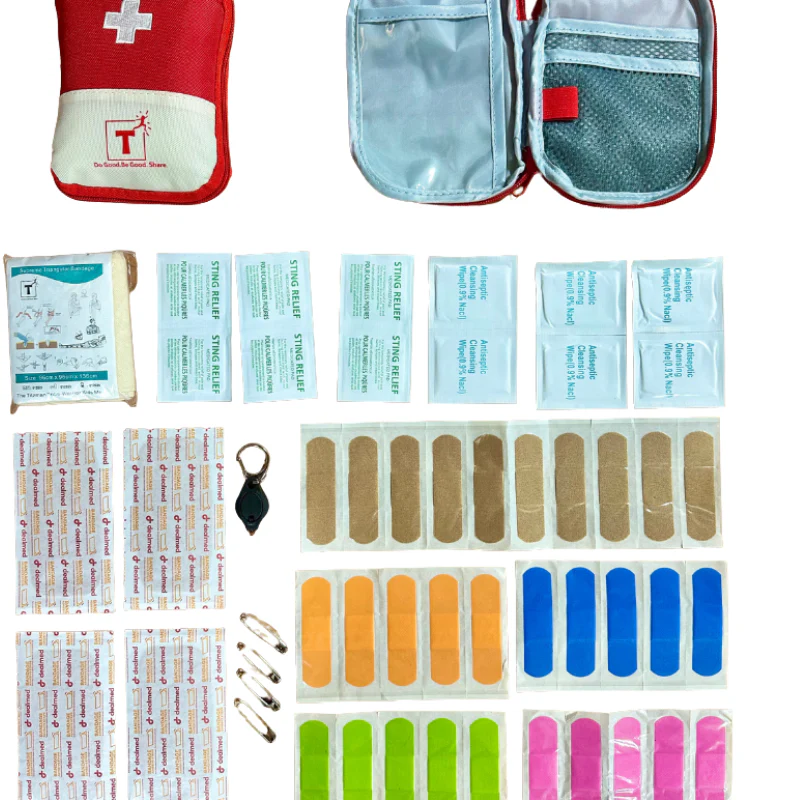
Dustin devoted nights and weekends to sourcing quality components for the kits. Manufacturing a medical product meant balancing durability with child safety. He sourced heavy-duty 100% cotton for the triangular bandage so it would hold up to repeated tying, washing, and even outdoor use. For the kit container, they chose a tough 600-denier ripstop nylon case that could survive being tossed into a school backpack or dragged on a camping trip. Inside, they stocked authentic first aid supplies scaled to a kid’s needs. Each compact kit (about 6 × 4.5 inches in size) contains real trauma shears with blunt safety tips, an assortment of adhesive bandages and sterile wound dressings, antiseptic wipes (saline, iodine, and sting-relief pads), a pair of tweezers for splinters, a mini LED flashlight, and even a silver emergency blanket/poncho. Recognizing that medication might be needed, they included small ziplock bags labeled “Personal Meds” so families can add items like EpiPens or allergy pills. Importantly, each Warrior Kid Medic Kit comes with two triangular bandages: one plain disposable cravat (for actual emergency use if needed) and one of Dustin’s reusable Multi-Tool bandages with the printed instructions. This way, kids can practice the techniques over and over with the cloth bandana, but still have a sterile bandage reserved for real injuries.
Every item in the kit was chosen with a purpose. “This kit has everything you need and nothing you don’t,” Dustin explains. Unlike novelty “kids’ kits” that might include stickers or toys, the Warrior Kid Medic kit is stocked for true emergencies – from heavy bleeding to broken bones. For example, the elastic bandage and tape can secure a splint or hold a dressing on a wound; the flashlight can help a child check pupils for a concussion or simply find supplies in the dark. The bright orange triangle bandage remains the star – its diagrams teach eight or nine different techniques, effectively serving as an instruction manual that a child can follow on the spot. The bandana shows how to fold it for a pressure bandage, how to tie it to make an arm sling, even how to roll it up to improvise a pad for an eye injury. Printed in bold text are calming reminders like “Your most powerful tool is your brain” and “You are a calm presence with common sense.” These phrases reinforce the training: if an emergency happens, don’t panic – think, breathe, remember what you practiced. The entire kit is intentionally “kid-friendly, adult-approved,” meaning it’s approachable for youngsters but not dumbed-down. Dustin himself carries the same kit in his truck, only adding a couple of advanced items like a chest seal for his own use. In short, the Titzmans have tried to make first aid feel accessible and even heroic for kids, rather than scary. As Dustin says, “We teach our kids they are not victims, but self-helpers. Not bystanders, but Good Samaritans… In short, you are a warrior.” It’s a message woven through the product and the training that comes with it.
By early 2024, Warrior Kid Medic had a name, a polished product, and growing grassroots demand. Dustin made the pivotal decision to retire from the San Antonio Fire Department after 21 years on the job, dedicating himself full-time to the family startup. The Titzmans initially fulfilled orders right from their home, assembling kits at the kitchen table and shipping them out to customers in the community. They sold their first kits and Multi-Tool bandages online, through their own website and on Amazon. Warrior Kid Medic officially appeared on Amazon in May 2024, and early buyers left 5-star reviews praising the concept. Without any big marketing campaigns, word spread organically. Many of the earliest customers were fellow first responders, paramedic instructors, and safety-conscious parents who had heard about the Titzmans’ project. Some EMTs who train community CPR classes, for instance, started ordering the bright orange bandages in bulk for their courses – a strong endorsement that the tools were useful beyond just kids. Summer camps that Michelle met at conferences began signing up for Warrior Kid Medic training sessions or purchasing kits for their counselors to have on hand. Locally, Dustin and Michelle ran pop-up first aid clinics for youth, teaching Scout troops and church youth groups the basics of bleeding control and first response. Each time, they brought along kits and bandages for participants to practice with (and often to take home afterward).
Today, Warrior Kid Medic is still very much a family-run venture. Dustin is the product designer and lead instructor; Michelle handles operations and outreach (with help from her sister, who acts as an unofficial publicist and cheerleader); even the Titzman kids contribute by testing new ideas and starring in how-to videos. Together they have turned their dining-room learning sessions into a growing social enterprise. The company’s motto — “Not a bystander; a Samaritan. Not a victim; a self-helper. In short, a warrior.” — reflects the Titzmans’ belief that anyone can save a life with a little knowledge and the willingness to act. They emphasize education as much as equipment: each kit comes with access to a library of training videos, and the family continues to offer live classes with realistic scenarios for both children and adults. By making first aid fun and approachable, the Titzmans are addressing a critical gap in preparedness. Emergencies can happen anytime – on the playground, at summer camp, or at home – and the first responder on the scene might well be a brave 10-year-old who knows what to do.
Looking back, Dustin and Michelle recognize that Warrior Kid Medic grew out of their own values and experiences coming together. It’s the blend of a firefighter’s practical know-how and a camp director’s youth development spirit. The journey hasn’t been easy – from hand-assembling early kits to navigating supply chain challenges for manufacturing – but their focus on “doing good” keeps them moving forward. As Michelle put it, “I just hope to inspire people to take that leap in whatever they feel like they are being called to do.” In their case, that calling was to raise a generation of kids who won’t freeze up or feel helpless when confronted with an injury, but will instead remember: take a deep breath, use your brain, and try to help. Dustin likes to compare it to wearing a seatbelt: “I don’t plan on using a seatbelt to save my family’s life when we get in the car, but I’m really glad they are there… The Warrior Kid Medic skills and tools are the same. You need to have them – your whole family does – even if you never use them.” In other words, it’s about being prepared for the worst while hoping for the best. With Warrior Kid Medic, the Titzman family has created a practical way for kids (and adults) to be prepared – and in the process, they are proving that caring for others is a skill and an attitude that can start at any age.