Mitch Braff was standing in a beautiful Pacific Heights home in San Francisco, looking out the window at a wall. Not a view. Just the side of another building—gray, blank, nothing.
The house had marble countertops, high ceilings, custom everything. But the dining room looked like it was carved into the inside of a shoebox. That stuck with him. Mitch wasn’t an architect or a builder. He was a filmmaker. He’d spent years shooting video, telling stories, and designing screens that brought images to life. And now he had a thought he couldn’t shake: What if the window wasn’t a window? What if it was a screen?
He didn’t mean a screen that played video clips or art loops. He meant a real, high-end, architectural window—but digital. With a lifelike view of the ocean. Or the Alps. Or Central Park at dusk. Something beautiful, in real time, that changed with the light. He called it LiquidView.
The First Window
The first prototype came together with help from IDEO, the design firm that has touched everything from the Apple mouse to the stand-up toothpaste tube. Mitch didn’t want the product to look like a mounted TV. He wanted trim. Depth. Recessed framing. Something that could sit flush inside a wall, glass over the screen, like an actual window. Then came the hard part: the view.
To build the illusion, Mitch hired a film crew and sent them out with Sony VENICE 2 cinema cameras to capture 24 continuous hours of footage from real-world locations. They set up tripods on beaches and balconies and rooftops and pressed record at sunrise. The footage had to be seamless, natural, and unedited—just what a person would see if they were actually there. The light had to shift with the day. The shadows had to stretch and disappear. If it rained, it rained. If birds flew through the frame, great.
Back at LiquidView’s studio, the raw video was trimmed into a 24-hour loop, paired with ambient sound, and stored on a hardwired player. The system synced the view to the user’s local time, so when it was 3 p.m. in your house, it was 3 p.m. in the footage. The light in the scene always matched the light in your room.
Not a TV
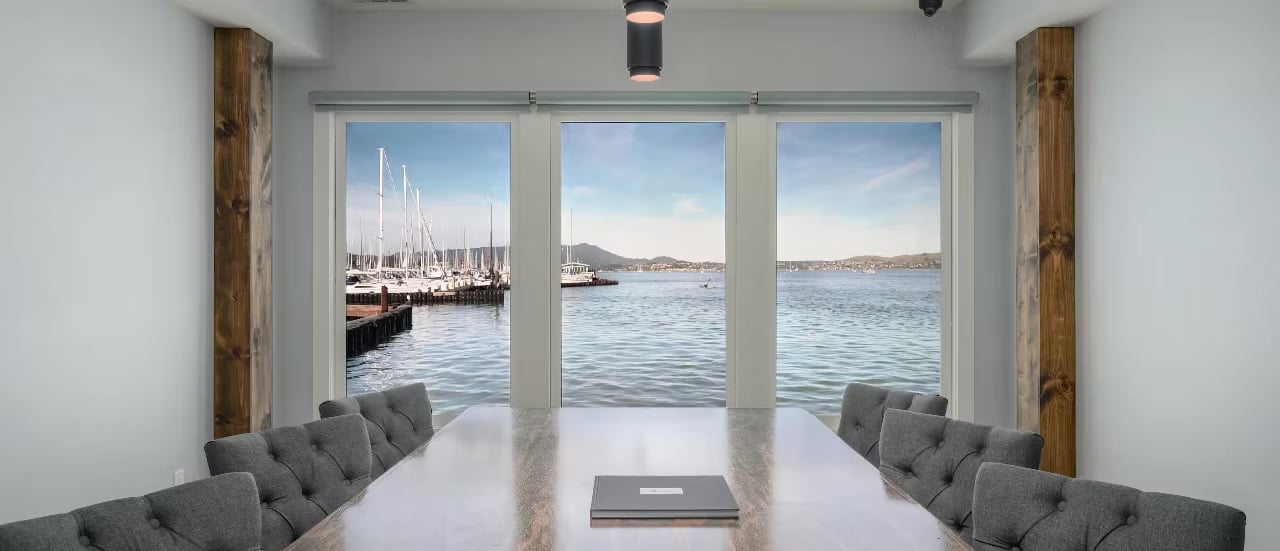
The screens themselves are commercial-grade 4K displays built for 24/7 runtime. The kind used in airports and control rooms. They don’t burn out. They don’t flicker. They’re framed and mounted like real windows. LiquidView installs them either recessed into the wall or mounted on top, depending on the space.
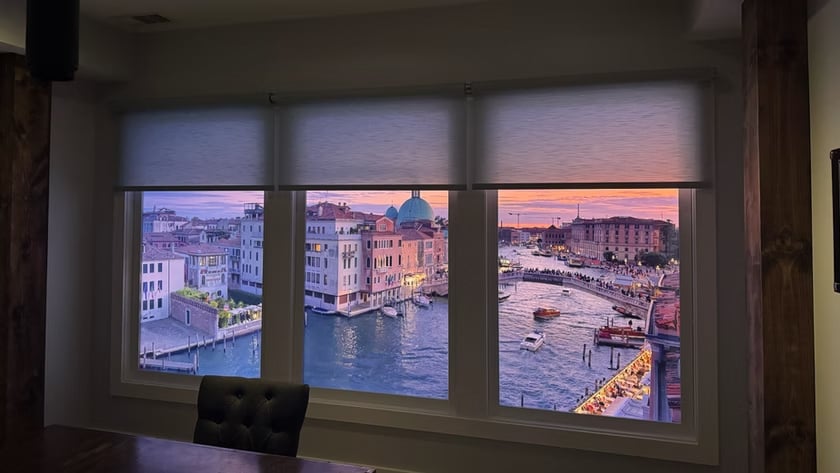
Customers can pick from a growing catalog of views—Paris rooftops, New York skyline, Sausalito marina, the cliffs above Rodeo Beach. Mitch’s team shoots a new one every month. They stitch together multi-screen panoramas if a client wants a wide view. And yes, there’s an app to change the scene.
It’s not cheap. A single-window setup can run $10,000 or more. A three-screen installation at a private club might hit $60,000. But it’s aimed at people who already spend that much on furniture or stone. One of LiquidView’s earliest installs was inside The Battery, a San Francisco club known for its low lighting and high design. They put it in a stairwell. The stairs didn’t go anywhere new. But the wall did.
Why Make This?
Mitch Braff didn’t start out in tech. He was a filmmaker, then a nonprofit media producer, then the founder of Liquid Canvas, which created high-end digital art displays. He was used to shooting visuals that felt alive and putting them into people’s spaces. The shift to windows was natural.
He talks a lot about how people feel when they see the windows for the first time. Not amazed—relieved. Especially in places without natural light: windowless gyms, basements, interior conference rooms, senior living centers. The first thing people tend to do is exhale.
One Stanford study tested heart rate and stress levels in people sitting in a dark room with and without a LiquidView display. The group with the virtual window saw stress indicators drop almost 50 percent. Their bodies reacted as if the view were real. That’s enough to make an office feel less like a box. Or a patient room feel less like a closet.
Mitch’s Rule
He has one rule: no drone shots. The camera never moves. No pans, no tilts. Just one fixed point for 24 hours. You wake up, it’s dawn. You eat dinner, it’s golden hour. You check back at midnight, the stars are out.
It’s not fast or flashy. That’s the point. Mitch wants the view to feel real enough that you stop looking at it—and just see it.