
Paul Huang was watching waves crash on the beach in Santa Cruz when his friend Davon Larson walked up wearing a bucket hat that looked like it had something hidden inside. Davon, who’d surfed for years and had a background in design, had been quietly working on a project since taking a bad hit from a fin in the head during a trip to Mexico. The cut was small, but the impact shook him. It didn’t feel like a close call at the time, but later it stuck with him. That’s how things often start—quietly, not dramatically.

He had searched for a surf helmet after the accident, but what he found felt like gear for another sport entirely. Big. Clunky. Shiny plastic that caught the sun and looked like something you’d wear kayaking or wakeboarding, not surfing. None of it blended in. Most of it looked like it would get you laughed out of the lineup. So he started working on his own idea: something protective that didn’t look like a helmet at all.
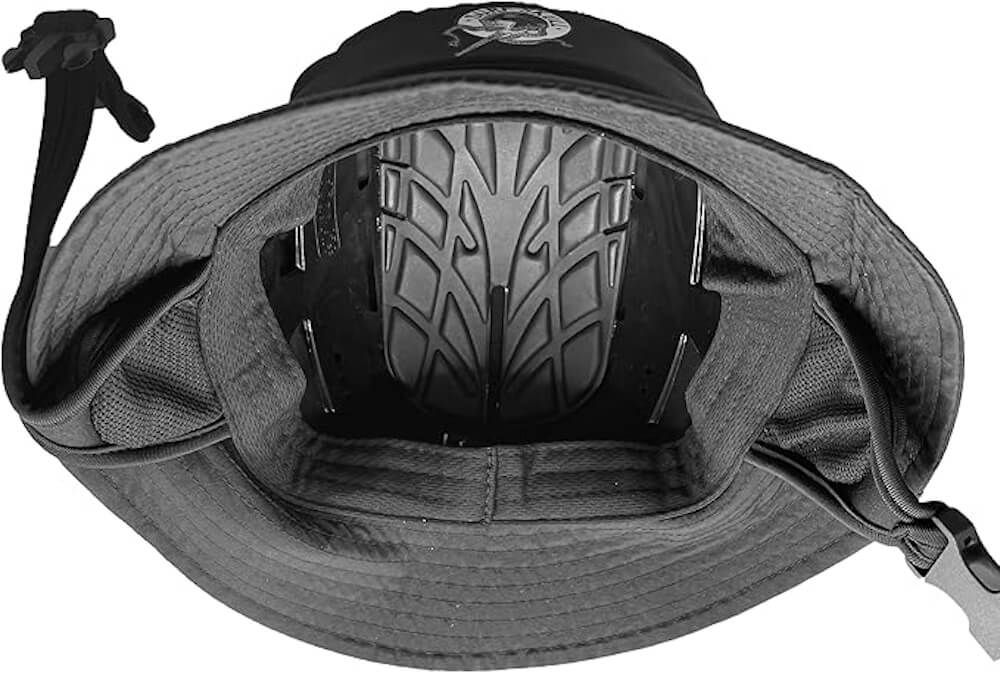
At first it was just a hat with a bump-cap insert—a hard ABS plastic shell with some EVA foam padding inside. It was the kind of protective liner used in warehouses or delivery jobs where people might bump into low beams. Davon shaped it to fit under a bucket hat and took it into the water. It stayed on. It didn’t feel awkward. It didn’t get in the way. That was enough for him to keep going.
He started refining the shape. He added ventilation, adjusted the foam density, tested how it fit with different styles of hats. It wasn’t a fashion project, but it couldn’t look like equipment either. The goal was something that would disappear into the background, a hat that happened to protect your head if your board or someone else’s clipped you in the wrong spot.
Paul got involved when the project started taking shape as a business. He had experience building things, running operations, and figuring out what it actually took to turn a personal solution into a product someone could buy. They roped in a few others—a soft-spoken engineer, a detail-oriented ops lead—and called it Surf Skull. No hype, no big roll-out. Just a local team in Santa Cruz making something they thought surfers might actually wear.
The first version was simple: a bucket hat with a hidden shell and chin strap. You couldn’t tell it was a helmet unless you picked it up. That was the point. They followed it with a baseball cap version, then a trucker style. People started noticing. Some surfers liked the idea of something discreet that stayed put when they duck-dived. Parents bought them for their kids. Others just liked that it didn’t scream “safety gear.”
When they launched version two, they added a slip-layer inside the helmet called “Reeflex”—a thin, movable lining meant to absorb rotational forces during impact. It wasn’t something you’d notice from the outside, but the inside padding shifted slightly when pressed, helping reduce head twist. They filed a patent and kept building. The new model still looked like a hat. It still had the same no-flash design. But inside, it had more going on.

The helmet meets CE safety standards for water sports, which means it qualifies as actual protective equipment. They don’t market it as crash-proof or invincible. They don’t promise you’ll never get hurt. It’s just a hat with a shell inside—something that might help when a fin clips your temple or your board flips under you on a shallow reef.
They sell them online, ship in simple packaging, and wear them themselves. Pricing lands around $79 for the original, closer to $150 for the upgraded model. Every once in a while, a customer writes to say the helmet helped during a fall. Most of the time, people just wear them and say nothing at all.
That’s fine with Paul and Davon. They’re not trying to rebrand surf culture. They’re just making hats that happen to protect your head.
